Combustion & Heat Management
Fire provides warmth, water purification, signaling capability, predator deterrence, and psychological comfort. The failure to secure a fire in freezing, damp conditions frequently results in hypothermia and death. Firecraft requires strict adherence to preparation; applying an ignition source before your fuel is ready is a guaranteed path to failure.
The Fire Triangle
Combustion requires three elements in precise balance: Heat, Oxygen, and Fuel. Remove any one, and the fire dies. Smothering a fire with thick logs too early cuts off oxygen; building on wet ground saps heat; using green wood deprives the fire of proper fuel. Every fire must be constructed with these principles in mind.
Fuel Classification
You cannot hold a lighter to a log and expect a fire. Fuel must be layered systematically.
- Tinder: Highly combustible material that ignites from a spark or minimal flame. Examples include birch bark, dry grasses, fatwood shavings, cattail fluff, or charred cotton cloth. Tinder must be bone dry.
- Kindling: Small sticks ranging from the thickness of a matchstick to the thickness of your thumb. Dead, standing wood (branches snapped from standing trees rather than picked off damp ground) is optimal.
- Fuel Wood: Larger branches and logs that will sustain the fire. Hardwoods like oak and maple burn long and hot, producing excellent coals. Softwoods like pine ignite faster but burn quickly and throw sparks.
Ignition Sources
Modern survival demands reliable ignition. Friction fire is a valuable backup skill, but relying on it exclusively in an emergency is foolish.
Ferrocerium Rods
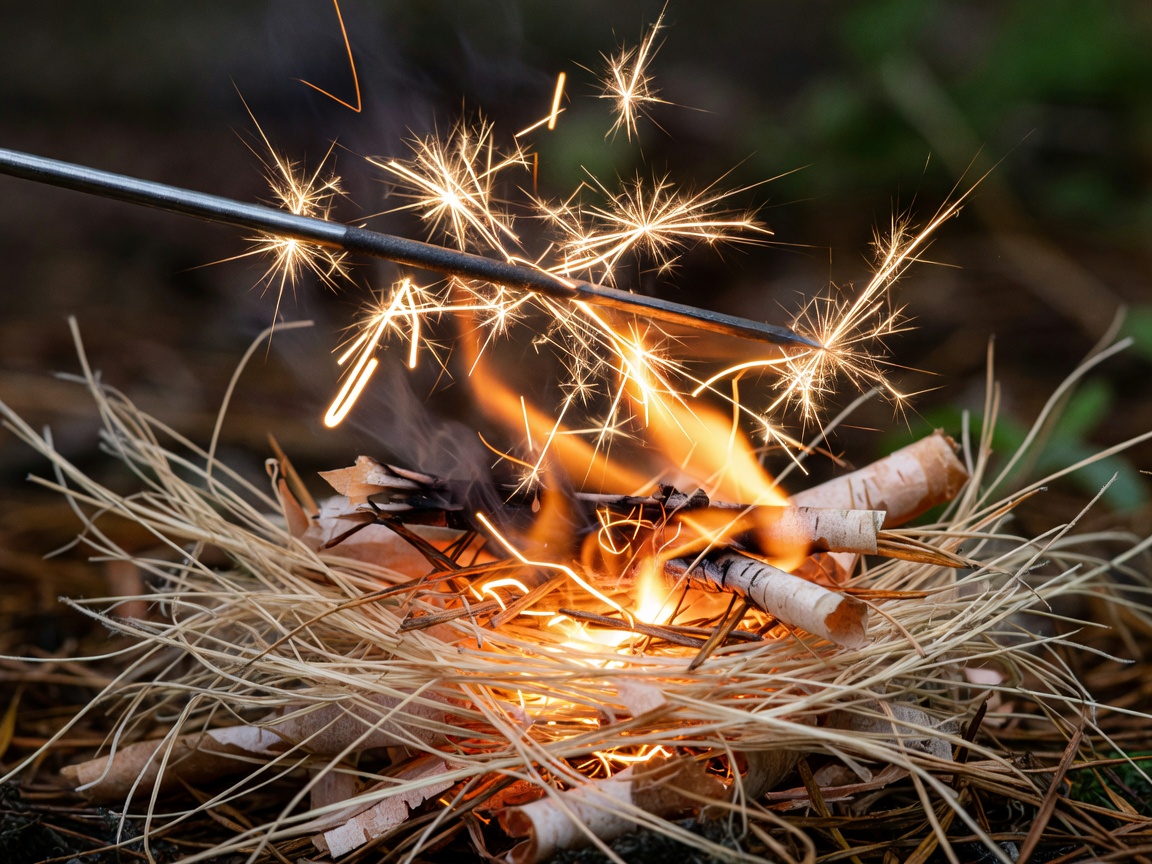
A ferro rod is a synthetic pyrophoric alloy that produces sparks burning at 3,000°C (5,430°F) when scraped with a sharp edge (like the spine of a fixed-blade knife). Unlike lighters, ferro rods work flawlessly when soaking wet and at extreme altitudes. They require excellent tinder preparation. Scraping the rod slowly to produce a heavy shower of sparks into a nest of scraped birch bark or petroleum-jelly-soaked cotton balls is highly effective.
Lighters and Matches
A standard disposable butane lighter is the single most efficient fire starter ever invented. However, butane vaporizes poorly at sub-freezing temperatures, causing lighters to fail in the cold unless kept close to body heat. Stormproof matches, coated in a combustible paste that burns vigorously even underwater, are excellent secondary options but offer a limited number of uses.
Friction Fire: The Bow Drill
When all modern tools are lost or exhausted, the bow drill utilizes mechanical friction to generate a smoldering coal.
- The Hearth Board: A flat piece of dry, medium-soft wood (like cedar, yucca, or cottonwood) with a small depression carved near the edge, accompanied by a v-notch cut into the side to allow the coal to fall.
- The Spindle: A straight, carved cylinder of the same or slightly harder wood.
- The Bow: A curved, sturdy stick strung with cordage (paracord, leather, or twisted plant fibers).
- The Bearing Block: A piece of hardwood, bone, or stone with a dimple to hold the top of the spindle while you apply downward pressure.
By wrapping the bowstring once around the spindle and moving the bow back and forth, the spindle grinds into the hearth board. The resulting dark dust collects in the notch. With sufficient speed and downward pressure, the friction ignites the dust into a coal. This coal is carefully transferred to a tinder bundle and blown into flame. This process requires significant stamina and perfectly selected, dry wood.
Fire Lays
Once ignition is achieved, the structure of your wood determines how the fire develops.
- Teepee: Kindling arranged in a cone over the tinder. Excellent draft pulls oxygen into the center, creating a rapid, hot flame. Good for boiling water quickly but consumes fuel fast.
- Log Cabin: Kindling stacked parallel in alternating layers (like a cabin). Extremely stable, allows great airflow, and collapses into a neat bed of coals for cooking.
- Upside-Down Fire: Large logs on the bottom, progressing to smaller kindling on top. The fire burns downward, requiring almost no maintenance for hours. Excellent for sleeping.